
President Prabowo underscores tourism's central role in Indonesia's economic strategy
At the inauguration of the restored Semarang Tawang Station, President Prabowo Subianto emphasized tourism's multiplier effect on the economy, urging regional governments to prioritize cleanliness and heritage preservation to attract international visitors.
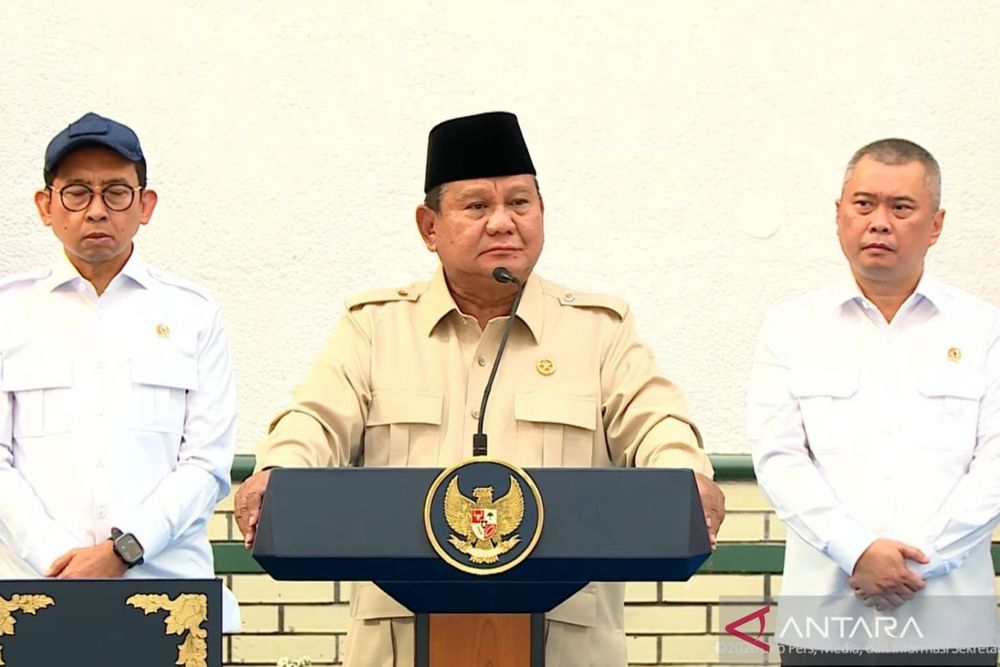
President Prabowo underscores tourism's central role in Indonesia's economic strategy
Indonesian President Prabowo Subianto underscored the strategic importance of tourism in driving national economic growth, highlighting its capacity to create ripple effects across multiple sectors and support millions of livelihoods.
Speaking at the inauguration of the revitalized Semarang Tawang Station in Central Java on Thursday, the president explained that every international visitor contributes not only foreign exchange but also income for countless Indonesians, from coffee farmers to hospitality workers and business owners.
"Tourism generates foreign exchange and stimulates economic growth. When a foreign tourist comes to our country and drinks a cup of coffee, a coffee farmer makes a living."
The tourism and travel sector contributed IDR 1,269.8 trillion (approximately €74 billion) to Indonesia's economy in 2025, accounting for 5.5% of GDP and marking a 21% increase over 2019 levels. The industry supported 25.91 million jobs as of the third quarter of 2025, representing roughly 9.3% of the nation's total workforce.
Indonesia exceeded its 2025 tourism targets, recording 15.39 million foreign tourist arrivals against a goal of 14-15 million, with visitors spending an average of US$1,267 each. The government now aims for 16 million to 17.6 million arrivals in 2026, expecting tourism's GDP contribution to rise to 4.5-4.7%.
Cultural heritage and natural beauty as core attractions
President Prabowo identified Indonesia's cultural richness, natural landscapes, and regional distinctiveness as the nation's primary draws for international tourists. He called on regional governments to prioritize environmental cleanliness to support tourism development.
Bali remains the dominant destination, contributing 55% of Indonesia's tourism foreign exchange earnings in 2025. The island attracted 7.05 million foreign tourists—45.8% of total arrivals—with average spending of US$1,552.44 per visitor. Malaysia led visitor numbers, accounting for 17.3% of arrivals, followed by Australia (11.3%), Singapore (10.5%), and China (8.8%).
Historic railway stations as tourism assets
The president commended state-owned railway company PT Kereta Api Indonesia for its initiative to restore historic stations, describing them as integral to the nation's identity and potential major tourist attractions.
Semarang Tawang Station, a heritage building designed by Dutch architect Sloth-Blauwboer and constructed between 1911 and 1914, underwent its first phase of revitalization over 240 days from May to December 2025, with a contract value of Rp12.39 billion.
"Revitalizing hundreds of stations is very important; it should not be taken lightly. Some tourists come specifically for history. They visit Central Java for Borobudur and Yogyakarta for Prambanan."
PT Kereta Api Indonesia operates approximately 400 stations across Java and Sumatra, with plans to revitalize hundreds as part of national infrastructure development.
President Prabowo stressed that Indonesia must maintain clean, well-organized surroundings free of waste and neglected structures to strengthen its position as a world-class tourist destination. He emphasized that preserving historic stations is essential for safeguarding cultural heritage while transforming Indonesia into a clean, scenic, and welcoming country for international visitors.
The government has identified 15 key source markets for 2025-2026: Malaysia, Singapore, Australia, China, India, Japan, South Korea, the United Kingdom, Germany, France, Russia, the Netherlands, Saudi Arabia, the United Arab Emirates, and the United States.