
Danantara plans major data center expansion amid Indonesia's digital infrastructure surge
Indonesia's sovereign wealth fund Danantara is preparing to expand data center investments as the country faces severe capacity shortages and year-long waiting times, with the market projected to more than double by 2031.
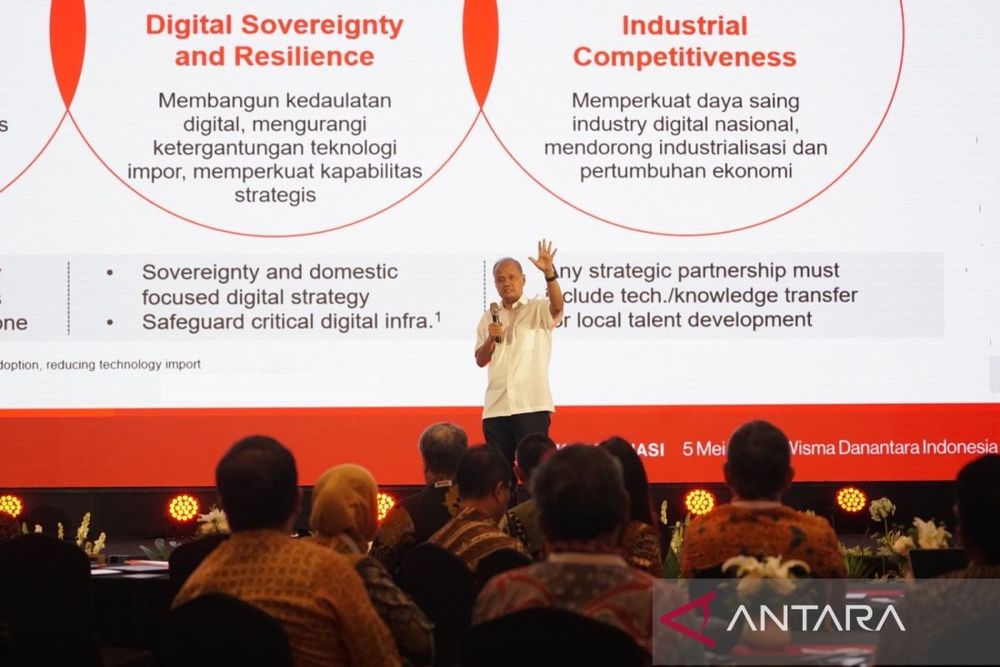
Danantara eyes wider data center investment as demand surges
Indonesia's sovereign investment agency Danantara is positioning itself for substantial expansion in the data center sector as booming demand creates critical capacity shortages across the archipelago, according to the fund's technology chief.
Sigit Puji Santosa, Chief Technology Officer of Danantara, told reporters in Jakarta on Thursday that newly constructed facilities are being absorbed by the market almost immediately, leaving customers waiting six months to a year for access to digital infrastructure.
"If we build 100 megawatts, 200 megawatts, it is immediately sold out," Sigit said, highlighting the severity of the supply-demand imbalance in Southeast Asia's largest economy.
Market growth outpaces infrastructure
Indonesia currently operates approximately 45 large-scale data centers, but capacity has struggled to keep pace with exploding demand from both domestic and international clients. The country's data center capacity reached 500-650 megawatts in 2025 and is projected to surge to as much as 1.7 gigawatts by year-end, with industry forecasts suggesting further expansion to 11.7 gigawatts by 2030.
Despite this rapid growth, Indonesia faces a projected one-gigawatt capacity shortfall by the end of the decade. Grid interconnection delays stretching three to five years compound the challenge, driven primarily by transmission infrastructure constraints rather than power generation limitations.
The financial stakes are considerable. Industry estimates indicate that every 100 megawatts of new data center capacity requires approximately one billion dollars in investment. Indonesia's data center market, valued at US$1.61 billion in 2025, is expected to more than double to US$3.48 billion by 2031.
Power demands reshape energy landscape
The expansion comes with significant energy implications. Data center electricity consumption is forecast to quadruple from 6.7 terawatt-hours in 2024 to 26 terawatt-hours by 2030, placing additional pressure on Indonesia's power grid, which still derives more than 60 percent of its electricity from coal-fired plants.
Sigit acknowledged that limited power capacity, coupled with complex regulatory processes, represents a major obstacle to development.
"The challenges are indeed quite significant, but the opportunities are also quite large," he said.
Semiconductor ambitions advance
Beyond data centers, Danantara is pushing forward with semiconductor development, particularly artificial intelligence chips where global demand has intensified. The agency signed a partnership with British semiconductor firm Arm Limited in February 2026, committing US$150 million to train 15,000 Indonesian engineers in chip design technology.
The collaboration with Arm, which controls approximately 96 percent of global automotive chip technology and nearly 94 percent of chip designs for data centers and AI applications, positions Indonesia to develop indigenous capabilities in a critical technology sector.
Waiting times for AI chips can extend six to nine months in some markets, Sigit noted, underscoring the strategic importance of domestic production capacity.
Regional competition intensifies
Indonesia's push comes as Southeast Asia emerges as a global data center hub. Regional investment in the sector is projected to climb from US$15.72 billion in 2025 to US$35.08 billion by 2031, with Indonesia competing alongside Singapore and Malaysia for market leadership.
Major international technology companies including Microsoft, CoreWeave, and Oracle are committing billions in Indonesian data center projects. Microsoft's first Indonesian facility, launched in May 2025, is expected to contribute US$2.5 billion to the economy and generate 60,000 jobs by 2028.
Established in February 2025, Danantara functions as Indonesia's second sovereign wealth fund, managing stakes in major state-owned enterprises including Bank Mandiri, Bank Rakyat Indonesia, Telkom, Pertamina, and PLN. The fund, modeled after Singapore's Temasek, oversees assets valued between US$900 billion and US$980 billion, making it the seventh-largest sovereign wealth fund globally.
Danantara plans to develop comprehensive digital infrastructure spanning systems, subsystems and supporting components to capture opportunities from the sector's expansion, Sigit said, as Indonesia positions itself as a regional digital powerhouse.