
Indonesia Expands Tuition-Free Sekolah Rakyat Program to Remote Regions
Home Affairs Minister Tito Karnavian coordinates with regional governments to secure sites for President Prabowo's free boarding schools targeting poor families, as the program grows from 15,000 to 45,000 students nationwide.
Indonesia Expands Tuition-Free Sekolah Rakyat Program to Remote Regions
Indonesia's Home Affairs Minister Tito Karnavian announced coordination efforts with regional governments to prepare sites for the expansion of Sekolah Rakyat, President Prabowo Subianto's tuition-free boarding school initiative aimed at children from impoverished families.
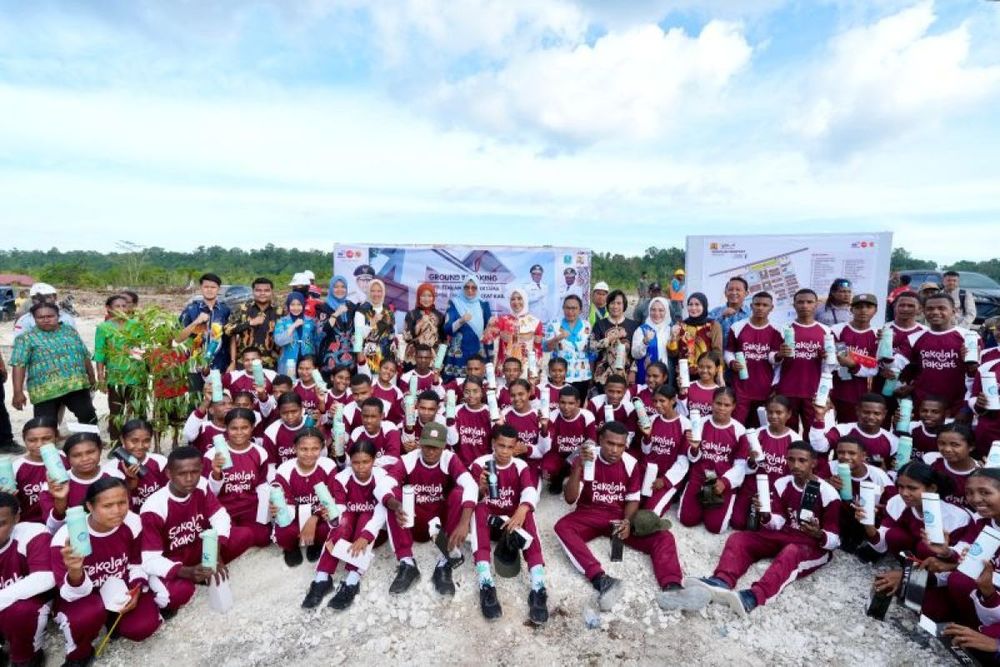
The minister outlined plans to maximize underutilized regional government assets for the program during a groundbreaking ceremony in Biak Numfor District, Papua Province, on Saturday. The remote regency, home to approximately 150,318 people at the northern entrance to Cenderawasih Bay, represents one of the priority areas for the program's expansion into historically underserved regions.
Sekolah Rakyat serves children from families classified as poor or extremely poor in the government's database, with the goal of providing pathways to improved futures through quality education. As of March 2025, approximately 23.85 million Indonesians lived below the poverty line of Rp 609,160 per month, representing 8.47 percent of the population—the lowest rate in two decades.
The program forms part of the government's broader poverty reduction strategy, which targets zero percent extreme poverty by 2026 and a national poverty rate below five percent by 2029. President Prabowo, who took office in October 2024, has prioritized poverty alleviation through strengthening vocational education and integrated school development at the sub-district level.
Full-Boarding School Model
All Sekolah Rakyat campuses adopt a full-boarding concept, with complexes comprising classrooms, dormitories, teachers' quarters, and sports facilities. This approach builds on Indonesia's established boarding school tradition, exemplified by over 40,000 pesantren Islamic boarding schools serving approximately 10 percent of the country's student population.
Minister Karnavian credited President Prabowo with initiating the program and described it as proof of the president's understanding of Indonesia's founding principles regarding equitable educational access. During his visit to Biak Numfor, the minister distributed 45 packages of staple goods to teachers and 88 drinking bottles to students.
Rapid National Expansion
Social Affairs Minister Saifullah Yusuf reported that Sekolah Rakyat has been operating since July 2025 at 166 locations nationwide, with most schools temporarily housed in existing government facilities. The government has begun constructing permanent campuses at more than 100 locations, each designed to accommodate between 2,000 and 2,500 students.
The program enrolled more than 15,000 students in its first year and plans to increase the admission quota by 30,000 students in 2026, Yusuf stated during remarks in Bandung, West Java, on July 23.
The expansion receives support from Indonesia's record-breaking 2026 education budget of Rp 757.8 trillion (approximately US$46.4 billion), representing 20 percent of the total state budget. The allocation prioritizes development of both Sekolah Rakyat and integrated high-quality high schools known as Sekolah Unggul Garuda as part of a dual-track strategy to increase equitable access to education.
Regional Priority Areas
Papua Province faces particular educational challenges, with remote highland areas historically experiencing uneven school distribution and teacher shortages, despite cities like Biak maintaining sufficient facilities from primary to university levels. The province's higher-than-average poverty rates make it a priority area for the program, alongside East Java, Central Java, and West Java, which have the highest absolute numbers of poor residents.
The Sekolah Rakyat initiative represents one component of President Prabowo's broader education transformation efforts. In 2025, the government renovated 16,140 schools and equipped 288,000 schools with 75-inch interactive flat panels as part of educational digitalization, with plans to add one million more smart panels in 2026.