
Government launches National Integrated Schools to tackle regional education gaps
Indonesia begins rolling out National Integrated Schools across 17 districts to address severe educational disparities, with Cianjur selected as a pilot location where only 2.7% of residents have tertiary education.
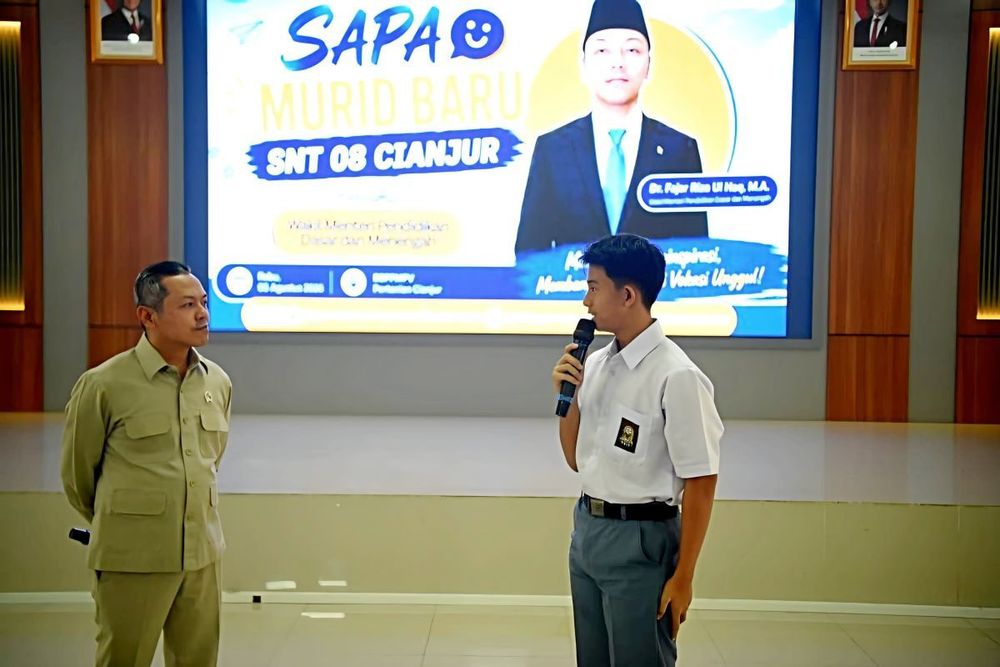
National Integrated Schools to drive regional talent development
Indonesia has begun implementing its National Integrated Schools (SNT) program to address persistent educational quality gaps between regions, with Deputy Minister of Primary and Secondary Education Fajar Riza Ul Haq describing the schools as future centers of educational excellence for their host communities.
Speaking at a dialogue with prospective SNT students in Cianjur District, West Java, on Wednesday, Fajar emphasized that the program represents a commitment to developing regional talent pipelines. The selection of Cianjur, a district of 2.58 million residents where only 2.7 percent hold tertiary qualifications and nearly a quarter have incomplete or no schooling, illustrates the program's focus on areas with the greatest educational needs.
"The presence of an SNT in Cianjur signifies that the district already has a center for education quality expected to produce the best generation for regional and national development," Fajar said.
The initiative comes amid significant challenges facing Indonesia's education sector, including a projected shortage of approximately 498,000 teachers in 2026 after accounting for retirements. The government has responded with substantial financial backing, allocating IDR 757.8 trillion (US$46.8 billion) to education in 2026, representing 20 percent of the national budget and the highest allocation in the country's history.
Infrastructure and teaching quality priorities
Fajar stressed that success depends on reliable infrastructure and qualified teaching staff, particularly urgent given the nationwide teacher shortage. The government plans to use existing state facilities as transition classrooms while permanent campuses are constructed.
"The government truly hopes for the younger generation nurtured by the schools to become part of Indonesia's leadership in the future," he added.
The program addresses systemic issues that have left only around 4 percent of Indonesia's sub-districts with high-quality secondary schools. These disparities stem from unequal distribution of qualified teachers, limited facilities, and significant regional differences in educational access. Despite a national literacy rate of 96.53 percent in 2023, rural areas lag considerably, with several rural provinces recording rates below 90 percent.
Deep learning approach for critical thinking
The deputy minister warned students about potential adverse impacts from rapid technological development, emphasizing the need to balance academic achievement with character development and critical thinking skills.
To meet this challenge, SNT will adopt a deep learning approach designed to foster habits of questioning, critical analysis, and idea expansion, enabling students to identify solutions to public issues.
Primary and Secondary Education Minister Abdul Mu'ti, who was appointed to lead the ministry in October 2024, had earlier announced plans to launch the program in 17 districts and cities during the 2026/2027 academic year, with a broader goal of establishing schools in 37 regions throughout 2026.
"Our objective is to prepare 500 schools gradually through 2029," said Mu'ti, who also serves as Secretary-General of Muhammadiyah, Indonesia's largest modernist Islamic movement with over 60 million members.
Local admissions priority
Admissions will prioritize local children to support nationwide improvements in education quality, according to Head of the Government Communication Agency Mohammad Qodari. This policy aims to reduce disparities by ensuring communities benefit directly from schools established in their regions.
The SNT program forms part of a broader education reform strategy under President Prabowo Subianto's administration. In 2025, the government renovated 16,140 schools nationwide and equipped 288,000 schools with interactive flat panel displays as part of digitalization efforts. The administration also launched the Sekolah Rakyat (People's School) program, which by November 2025 had established 166 schools serving approximately 16,000 students from underprivileged families with full-boarding education.
President Prabowo further announced plans in February 2026 to build 10 new universities, including a dedicated institution for public administration, with the first student intake targeted for 2028, demonstrating a comprehensive approach to talent development from primary through higher education.