
Indonesia accelerates investment reforms as capital leads national growth
Minister Rosan Roeslani outlines regulatory improvements and project debottlenecking measures as Jakarta accounts for 17.2% of national investment in H1 2026, with downstreaming policy expanding beyond minerals into digital infrastructure and technology sectors.
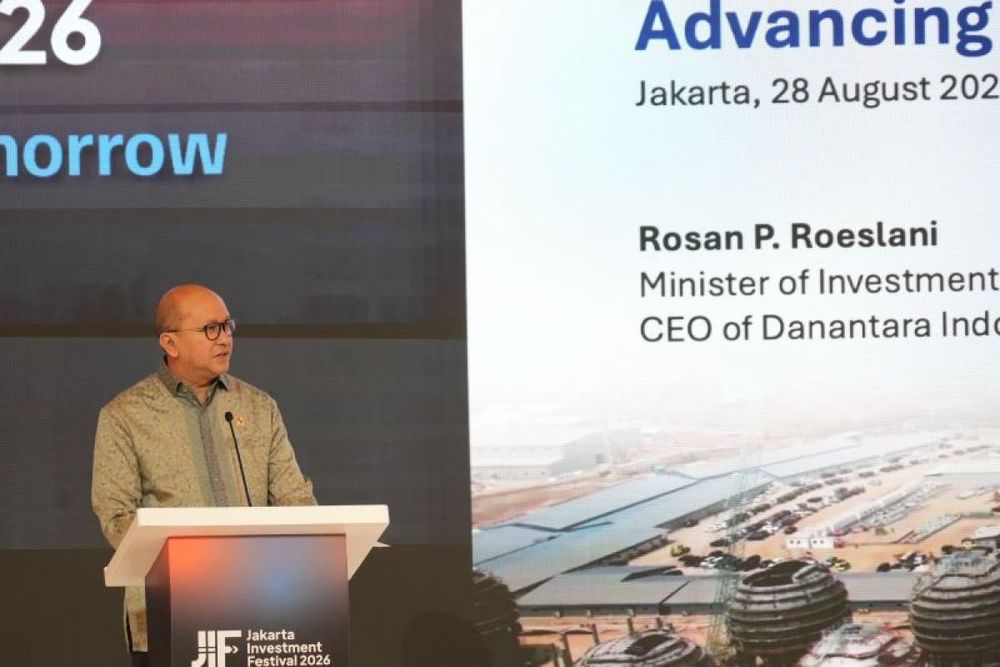
Indonesia accelerates investment reforms as capital leads national growth
Indonesia is strengthening its investment framework through streamlined licensing, enhanced legal certainty, and systematic removal of operational obstacles as the country seeks to position itself as a leading destination for next-generation global capital.
Investment and Downstreaming Minister Rosan Roeslani, who also serves as CEO of Danantara, Indonesia's sovereign wealth fund, addressed the Jakarta Investment Festival Summit on Friday, emphasizing that regulatory predictability and infrastructure reliability now rank alongside traditional factors like production costs in investors' decision-making processes.
The two-day summit, held August 27-28 under the theme "Advancing Today, Securing Tomorrow," featured three themed pavilions addressing future urban development, innovation commercialization, and capital connectivity. The event showcased 40 strategic investment projects valued at Rp271.3 trillion from state-owned enterprises and public service agencies spanning transportation, property, utilities, logistics, and integrated development zones.
Downstreaming strategy evolves beyond minerals
Roeslani outlined an expanded vision for Indonesia's downstreaming policy, which historically focused on mineral processing. The 2020 ban on raw nickel ore exports exemplifies this approach, having attracted over $30 billion in investment primarily from Chinese companies to build domestic smelters and processing facilities.
The next stage of downstreaming will not only focus on minerals and their processing but will also expand into digital infrastructure, technology, innovation, and industry, which will determine future global growth.
Downstream investment reached Rp300.1 trillion in the first half of 2026, representing 29.7% of total national investment. While mineral commodities including bauxite, nickel, copper, iron and steel, and silica sand continue to dominate the sector, the government aims to diversify into technology-intensive industries.
National investment on track
Indonesia recorded Rp1,010.6 trillion (approximately US$56.1 billion) in total investment realization during the first half of 2026, achieving 49.5% of the annual target of Rp2,041.3 trillion. The Ministry of Investment and Downstreaming, elevated to full cabinet ministry status in April 2021 after operating since 1973 as the Investment Coordinating Board, reported that these investments generated 1.44 million jobs, marking a 15% year-on-year increase.
Singapore maintained its position as Indonesia's largest foreign investor with US$8.8 billion, followed by Hong Kong at US$7.6 billion, China at US$3.9 billion, Japan at US$1.9 billion, and the United States at US$1.7 billion. These five economies collectively accounted for 77.8% of total foreign direct investment.
In a significant milestone for regional development, investment outside Java Island exceeded investment within Java for the first time, with regions beyond Java receiving Rp507.8 trillion (50.2%) compared to Java's Rp502.8 trillion (49.8%).
Jakarta maintains investment leadership
Despite the geographic diversification, Jakarta retained its position as the country's premier investment destination. The capital recorded Rp173.6 trillion (approximately US$10.7 billion) in investment during the first semester, accounting for 17.2% of national totals and securing first place in regional rankings. The city also contributed 16.3% of Indonesia's Gross Domestic Product in the second quarter.
The transportation, warehousing, and telecommunications sectors led Jakarta's investment landscape at Rp54.4 trillion (US$3.35 billion), followed by service industries at Rp43.6 trillion (US$2.68 billion), trade and vehicle repairs at Rp28.4 trillion (US$1.75 billion), housing and office space at Rp14 trillion (US$862 million), and construction at Rp12.9 trillion (US$794 million).
Jakarta almost always ranks among the top five, even ranking first this semester,Roeslani noted, adding that the ministry would maintain close coordination with the Jakarta Provincial Government to facilitate strategic projects and sustain the capital's competitive position in attracting high-quality investment.