
Indonesia and Saudi Arabia sign investment cooperation agreement to strengthen bilateral economic ties
Indonesia and Saudi Arabia have formalized a Memorandum of Understanding on direct investment cooperation, building on $31.5 billion in bilateral trade over the past five years and recent $27 billion deals signed in 2025.
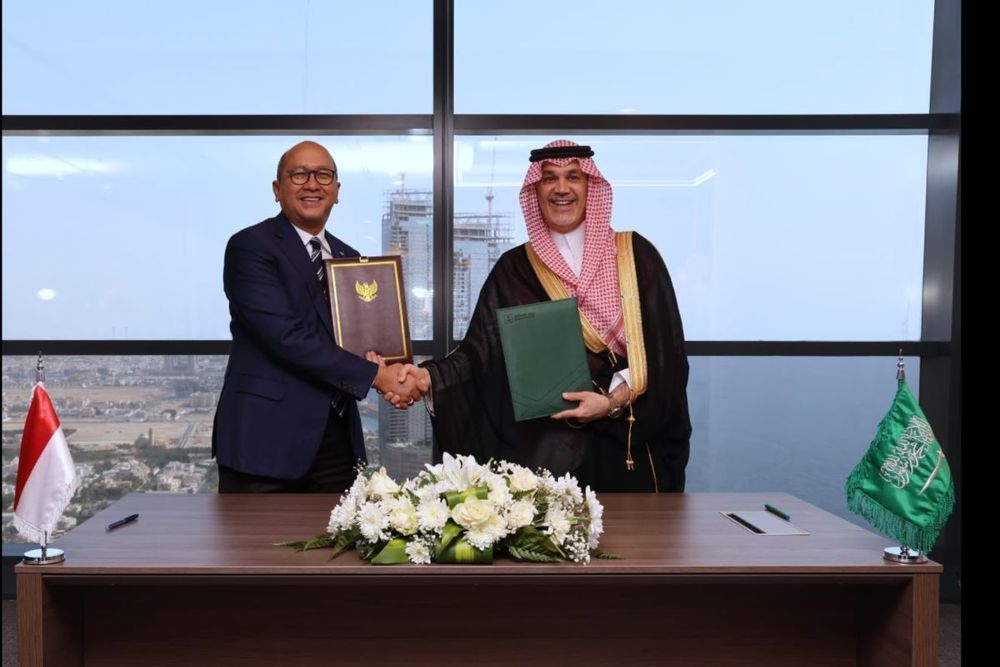
Indonesia, Saudi Arabia sign MoU to boost direct foreign investment
Indonesia and Saudi Arabia formalized a Memorandum of Understanding on Cooperation and Promotion of Direct Investment on Tuesday, August 4, 2026, marking a significant step in elevating bilateral economic relations and facilitating cross-border capital flows between the two nations.
The agreement was signed by Indonesian Minister of Investment and Downstreaming Rosan Roeslani and Saudi Arabian Minister of Investment Fahad bin Abduljalil Al-Saif. Roeslani, who previously served as Indonesia's ambassador to the United States from 2021 to 2023 and chaired the Indonesian Chamber of Commerce and Industry from 2015 to 2021, emphasized that the partnership reflects mutual trust and long-standing people-to-people ties.
The MoU builds on a substantial foundation of existing economic cooperation. Bilateral trade between the two countries reached approximately $31.5 billion over the past five years, with Saudi Arabia becoming Indonesia's leading trading partner in the region. In 2024 alone, bilateral trade totaled $6.5 billion. This new investment agreement follows major commitments made during President Prabowo Subianto's state visit to Saudi Arabia in March 2025, when both nations signed agreements worth $27 billion covering clean energy, petrochemicals, mineral resources, mining, and sustainable supply chain development.
According to data from Indonesia's Ministry of Investment, Saudi Arabia's realized Foreign Direct Investment in Indonesia reached $126.2 million between 2021 and the first half of 2026. The new agreement aims to significantly expand this investment flow through enhanced cooperation mechanisms.
Strategic alignment of development goals
Roeslani noted that shifts in the global economic landscape are prompting nations to forge resilient partnerships, as modern investors prioritize market stability, regulatory certainty and long-term prospects over cost efficiency alone. He highlighted the strategic alignment between Saudi Arabia's Vision 2030 modernization agenda and Indonesia's accelerating industrialization and economic transformation.
Saudi Arabia's Vision 2030 National Investment Strategy, announced in October 2021, targets net foreign direct investment flows of $103 billion annually by 2030 and aims to raise foreign direct investment to 5.7 percent of total GDP. The strategy encompasses SAR 12.4 trillion in cumulative domestic investment across thirteen priority sectors including manufacturing, renewable energy, transport and logistics, tourism, digital infrastructure, and healthcare.
Indonesia's downstreaming policy, strengthened by export bans on nickel ore in 2020 and other mineral exports in 2023, has transformed the country from a raw commodity exporter into a central player in global industrial supply chains. The policy achieved realized downstream investment of Rp147.5 trillion ($9.3 billion) in the first quarter of 2026, accounting for 29.6 percent of Indonesia's total national investment. The United Nations Industrial Development Organization recognized Indonesia's downstreaming strategy in its 2026 Industrial Development Report, positioning the country as a model for downstream-based industrial development.
Geographic distribution and investment growth
Approximately 75 percent of all downstream investment in Indonesia is now located outside Java, with mineral-producing provinces transforming into industrial centers. Central Sulawesi alone drew Rp32.1 trillion ($2.03 billion) in investment in the first quarter of 2026, representing 6.4 percent of total national investment.
Indonesia's overall foreign direct investment grew 8.5 percent year-on-year to IDR 250.0 trillion in the first quarter of 2026, marking the second consecutive quarter of growth and representing 50.1 percent of total investment realization.
Framework for cooperation
Under the terms of the MoU, both countries committed to strengthening direct investment cooperation through several mechanisms. These include sharing statistical data, exchanging investment information, updating regulatory frameworks, facilitating private-sector consultations, conducting joint investment promotion campaigns, exchanging expert delegations, and sharing technical knowledge. The agreement also serves as a platform for strengthening institutional coordination between the investment authorities of both nations.
Roeslani emphasized that the agreement's success will be measured by concrete implementation rather than the signing itself. He said the partnership aims to generate new investment, expand business partnerships, create jobs, and deliver tangible prosperity to the people of both nations.
Indonesia is open to investment. Indonesia is committed to reform. We welcome investments that create added value, encourage knowledge transfer, develop industry, and generate shared prosperity.