
Indonesia deploys domestically developed high-yield corn seed to boost national production
Agriculture Minister Andi Amran Sulaiman announced the distribution of MTE-09 hybrid corn seeds developed by ITS to farmers in East Java, part of Indonesia's push toward corn self-sufficiency as the country aims to eliminate imports and resume exports.
Indonesia deploys domestically developed high-yield corn seed to boost national production
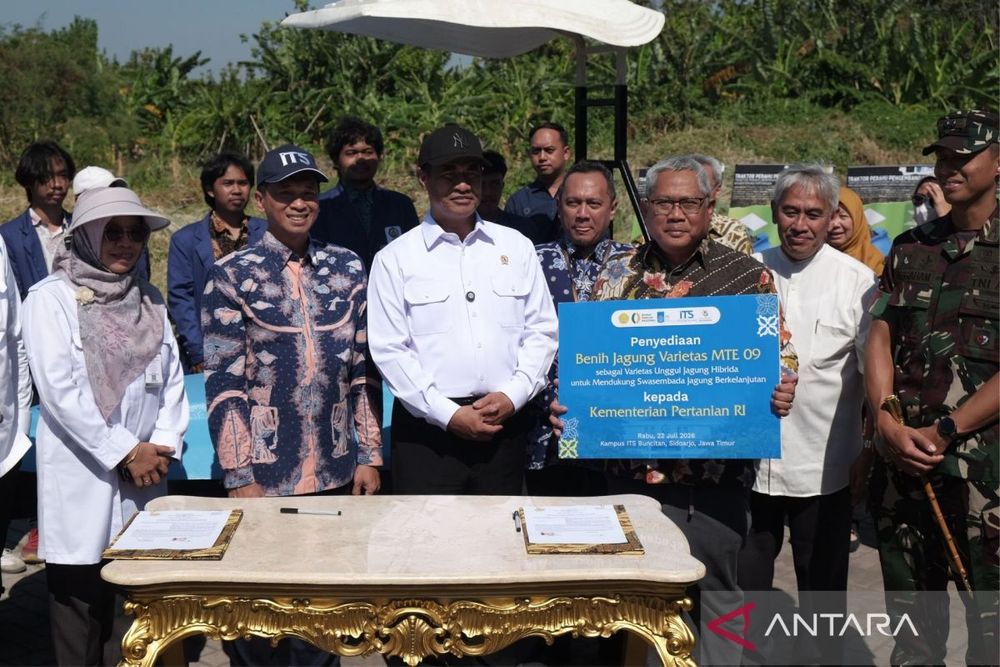
Indonesia's Ministry of Agriculture has purchased 13,000 hectares worth of MTE-09 hybrid corn seeds developed by Institut Teknologi Sepuluh Nopember (ITS) for free distribution to farmers in the Surabaya area, marking a significant step in the government's strategy to boost domestic corn production and achieve self-sufficiency.
Agriculture Minister Andi Amran Sulaiman, who also heads the National Food Agency, announced the Rp10 billion procurement during a cooperation agreement signing ceremony at ITS's Buncitan Campus in Sidoarjo, East Java, on Wednesday. The minister said the MTE-09 variety was selected because its productivity substantially exceeds the national average.
Significant productivity gains over national average
The MTE-09 hybrid seed can produce approximately 10 metric tons of shelled corn per hectare, significantly outperforming the national average yield of 5.94 metric tons per hectare recorded by Statistics Indonesia in 2024. This productivity gain is particularly important for Java, which accounts for 40 percent of Indonesia's national corn production, making it the country's primary corn-producing region.
The seeds will be planted in areas where ITS researchers can monitor the entire cultivation process from planting through harvest, ensuring farmers achieve the targeted 10 metric tons per hectare yield. ITS, established in 1960 in Surabaya, has emerged as a leading university in science, technology, and innovation in Indonesia, with research areas spanning agri-food and biotechnology.
Part of broader domestic technology initiative
The MTE-09 deployment forms part of a broader government initiative prioritizing domestically developed agricultural technology. The ministry has also ordered amphibious electric tractors and coconut tree-climbing devices developed by ITS, demonstrating the administration's commitment to supporting Indonesian university research.
Indonesia's corn production for the 2025/26 marketing year is projected at 13.3 million metric tons, representing a 2 percent increase from the previous year, with harvested area reaching a record 3.6 million hectares. The country announced earlier this year that it would not import corn for consumption in 2026 due to sufficient domestic production, with initial stocks of 4.5 million tons and planned production of 18 million tons enabling plans to resume corn exports.
Policy shift toward self-sufficiency
This policy shift toward self-sufficiency has led the government to reduce corn import quotas for industry in 2025/26, causing corn wet millers to temporarily shut down in late 2025. The distribution of high-yield hybrid seeds continues a strategy the Ministry of Agriculture initiated in 2018 to increase corn production through improved seed varieties, particularly targeting farmers using lower-productivity seeds.
Minister Amran emphasized that adopting advanced technology is essential for increasing agricultural productivity without expanding farmland, while supporting the development of strategic commodities including corn, rice, and coconuts. He stressed the importance of strengthening collaboration among government, industry, and universities through the triple helix approach to transform research and innovation into products benefiting the wider public.
ITS Rector Prof Bambang Pramujati reaffirmed the university's commitment to supporting government programs through innovation in agricultural mechanization and food production technologies. He indicated that if trial results prove satisfactory, the university will collaborate with industry partners to produce these innovations on a mass scale.
The government has allocated substantial funding to procure agricultural innovations developed by Indonesian universities as part of its broader support for domestic research and development in the agricultural sector.