
Indonesia reports strong food security gains as agricultural production surges
Indonesia demonstrates progress toward food self-sufficiency with rice production reaching 34.69 million tons in 2025, government reserves hitting record levels, and projected surpluses in eight of 11 strategic food commodities.
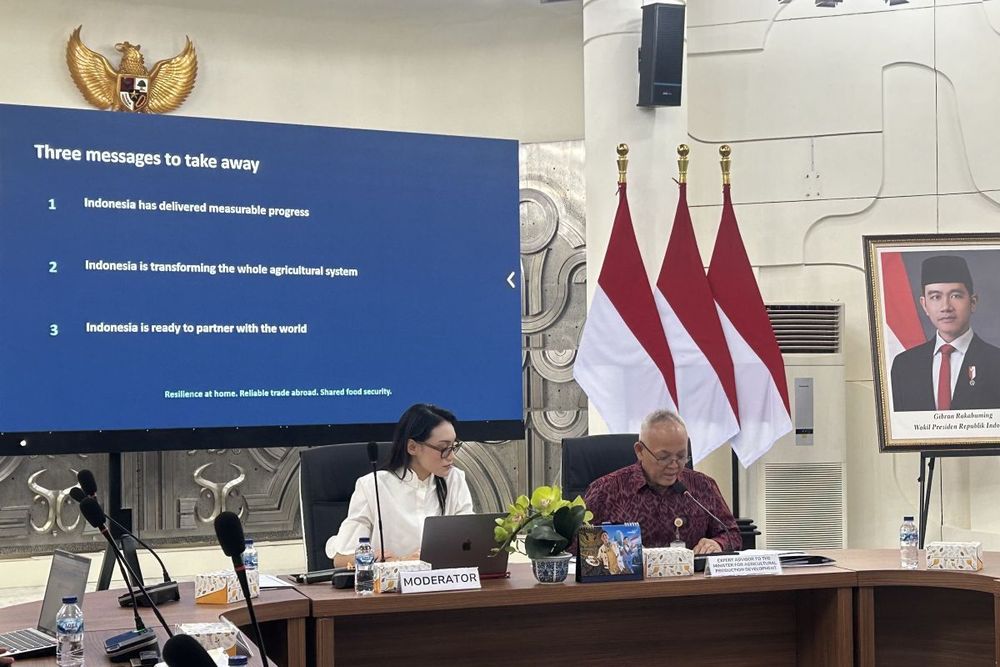
Indonesia confident on food security outlook as farm output rises
Indonesia has expressed confidence in its food security outlook, citing rising agricultural production, strengthened government reserves, and improved policy incentives as the nation advances efforts to build a more productive and self-sufficient food system.
Hasil Sembiring, Special Adviser to the Minister of Agriculture for Agricultural Production Enhancement, said on Monday that Indonesia had made measurable progress toward food self-sufficiency since President Prabowo Subianto took office in October 2024.
Rice production reached 34.69 million tons in 2025, according to Statistics Indonesia (BPS), representing a substantial increase of 4.07 million tons, or approximately 13.29 percent, from the previous year. The 2025 figure marks a significant turnaround from 2024, when production stood at approximately 30.62 million tons, down 1.54 percent from 31.1 million tons in 2023.
The production gains have allowed Indonesia to exceed domestic consumption levels, estimated at approximately 31 million tons annually, excluding hotels, restaurants, and catering services. This achievement comes after the country imported 7 million tons of rice between 2023 and 2024, valued at nearly Rp 100 trillion (approximately $6 billion).
Government rice reserves reached a record 5.25 million tons on July 30, 2026, Sembiring told a media briefing organized by the Government Communication Agency (Bakom RI) in Jakarta.
Indonesia's rice production is projected to reach 38.6 million tons in the 2026/2027 marketing year, up 0.2 percent from the previous year. According to the Food and Agriculture Organization (FAO), Indonesia ranks as the fourth-largest rice producer globally in 2025, after India, China, and Bangladesh, while maintaining its position as the largest producer in Southeast Asia alongside Vietnam and Thailand.
Positive outlook amid global challenges
Sembiring said Indonesia's rice production outlook remained positive despite forecasts of declining global rice output due to El Niño impacts and shrinking planting areas in several countries. The country's high per capita rice consumption, recorded at 185 kilograms per person annually, making it the tenth-highest globally, underscores the critical importance of maintaining production levels.
Beyond rice, Indonesia has made progress toward self-sufficiency in other strategic food commodities. The government has designated 11 strategic foods: rice, large chillies, bird's eye chillies, corn, sugar, chicken meat, chicken eggs, shallots, garlic, soybeans, and beef.
According to the government's 2026 Food Balance Projection, Indonesia is expected to record production surpluses in eight of those commodities: rice, large chillies, bird's eye chillies, corn, sugar, chicken meat, chicken eggs, and shallots. Indonesia could also become an exporter of chicken meat, chicken eggs, and shallots, Sembiring noted.
Agricultural reforms drive results
Sembiring attributed the progress to comprehensive reforms across the agricultural production system, including timely access to farm inputs, improved water availability, mechanization, higher-quality seeds, better farmer protection, and stronger farm-gate incentives.
The government is working to modernize traditional farming through modern rice cultivation methods, drone-based seeding, robotic planting, pump irrigation, and other technologies. These advances are strengthening Indonesia's resilience to climate-related challenges, including El Niño, Sembiring said.
Agriculture, forestry, and fishing contributed approximately 12.61 percent to Indonesia's GDP in 2024, with the sector remaining one of the largest sources of employment for millions of Indonesians, highlighting the broader economic significance of the food security initiatives.
Food self-sufficiency represents one of Prabowo's flagship policy priorities. The government initially targeted achieving the goal within four years but brought the timeline forward after Indonesia achieved rice self-sufficiency in December 2025, approximately one year into Prabowo's administration.
Indonesia has demonstrated measurable progress, marked by a sharp increase in rice production in 2025, stronger public food reserves, and improved incentives for farmers, demonstrating that coordinated reforms can deliver results. Therefore, we present our progress with confidence.
Sembiring said.